By Loris Comba, Co-founder and CEO of Forte AI
⚡ Quick summary. Watch a top mix engineer open a session and the first thirty minutes are about session prep, not plugins. Templates, routing, gain structure, references. The reason pros mix faster is not better EQ choices. It is that they have removed every non-musical task from the moment their ears get involved. This article breaks down the six prep habits that show up consistently across the engineers featured on Mix with the Masters and Produce Like a Pro, and where fMusic automates the layer (Auto routing, AI-R, Strip silence, Stereo to mono, Favorite stem prints, Multi-format bounce, Multi-session flow, Mix template integration) for engineers running high session volumes in Pro Tools or Logic Pro.
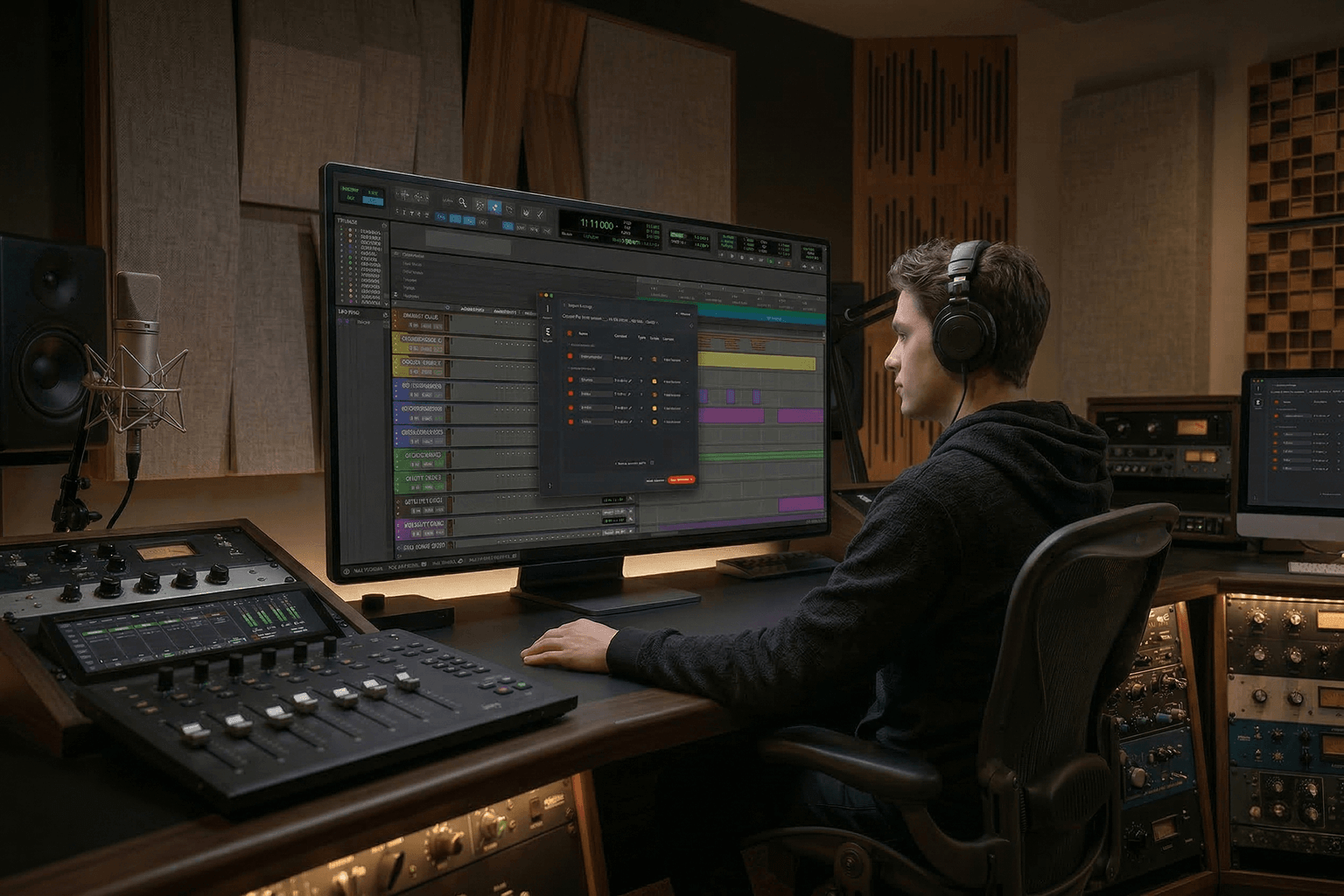
Watch a top mix engineer open a session for the first time. The first thirty minutes are not about EQ, compression, or any plugin. They are about session prep. Templates, routing, gain structure, references.
Most mixing-workflow articles describe the mix itself: balance, processing, automation, effects, finalize. That is downstream work. The reason pro engineers mix faster and cleaner is not better plugin choices. It is that they have removed every non-musical task from the moment their ears get involved.
This article focuses on the prep layer that sits before any of the standard mixing steps. Six habits that the engineers featured on Mix with the Masters and Produce Like a Pro run before the first fader move, how to apply each one in Pro Tools or Logic Pro, and where fMusic (Forte AI's mix prep and stem export automation product) closes the layer so the session opens ready for the music.
The 5-Step Mixing Workflow at a Glance
Most published workflows agree on the broad sequence. The version below is the consensus shape across the top guides. This article zooms in on the prep layer that sits in front of step 1.
| Step | What it covers | Where this article focuses |
|---|---|---|
| 0. Session prep | Template, routing, gain structure, references, strip silence | The full six-habit breakdown below |
| 1. Organize and balance | Rough balance, panning, basic fader positions | Covered in the routing and gain sections |
| 2. Process tracks | EQ, compression, saturation per element | Out of scope, downstream of prep |
| 3. Bus processing and effects | Group buses, reverb, delay, parallel chains | Routing structure is set up in prep |
| 4. Automation | Volume riding, parameter automation, rides | Out of scope, downstream of prep |
| 5. Print and deliver | Print versions, stem export, multi-format delivery | Wired in at prep, not at delivery night |
The downstream steps are well covered elsewhere. The compounding gains are in step 0.
Why Session Prep Beats Technique
Mixing is a creative act. Creative decisions need mental bandwidth. Every minute spent renaming tracks, chasing routing errors, or hunting for the second drum overhead is a minute your ears are not on the music.
The engineers featured on Mix with the Masters and on Produce Like a Pro do not mix faster because they are technically gifted. They mix faster because they have eliminated friction from every non-creative step before the first fader move. Sound on Sound has covered this pattern across years of professional mixer profiles: the time gap between top-tier and mid-tier engineers shows up more often in prep than in plugin choice. The six habits below are how the pros prep.
| Where most sessions lose time | What the pros do instead | Where fMusic helps |
|---|---|---|
| Rebuilding routing per session | Reusable mix template with locked routing | Mix template integration on import |
| Renaming, color-coding by hand | Naming and color conventions decided once | Auto renaming + Auto color-coding via AI-R |
| Fake-stereo files left as stereo | Mono-correct on import | Stereo to mono on import |
| Cleaning silences mid-mix | Strip silence on the broad pass before mixing | Strip silence (safe pass, tails preserved) |
1. Build a Mix Template You Never Have to Rebuild
The most consistent habit across high-volume engineers is a fixed mix template. Michael Brauer, whose multi-buss approach is one of the most studied workflows in the Mix with the Masters library, built his entire process around a signal routing structure he does not rebuild for every project. He drops material into a system that is already configured the way he thinks.
The same principle scales to any working engineer. A solid template means buses are in place, aux sends are pre-routed, monitoring chains are ready, and color coding is consistent before a single file lands in the session. When a project hits your inbox, you start from a foundation instead of from zero.
A working Pro Tools template typically covers:
| Layer | What it holds | Why it has to be pre-built |
|---|---|---|
| Routing folders | Drums, bass, guitars, keys, vocals, FX | Fastest signal flow to bus processing |
| Aux returns | Short plate, long hall, vocal delay, drum room | Sends are pre-wired so reverb decisions are tonal, not setup |
| Bus chains | Drum bus, vocal bus, mix bus | Group-level tone is locked before any track moves |
| Print tracks | Master print, vocal up, vocal down, instrumental, stems | Delivery infrastructure exists before mixing begins |
| Color and naming | Instrument family palette, naming convention | Read-at-a-glance session, no cognitive load to navigate |
Setting up the template is half the work. The other half is getting incoming files routed into it consistently. When someone sends 80 poorly labeled files for a tracking session, that import phase can eat the first hour before you have heard anything.
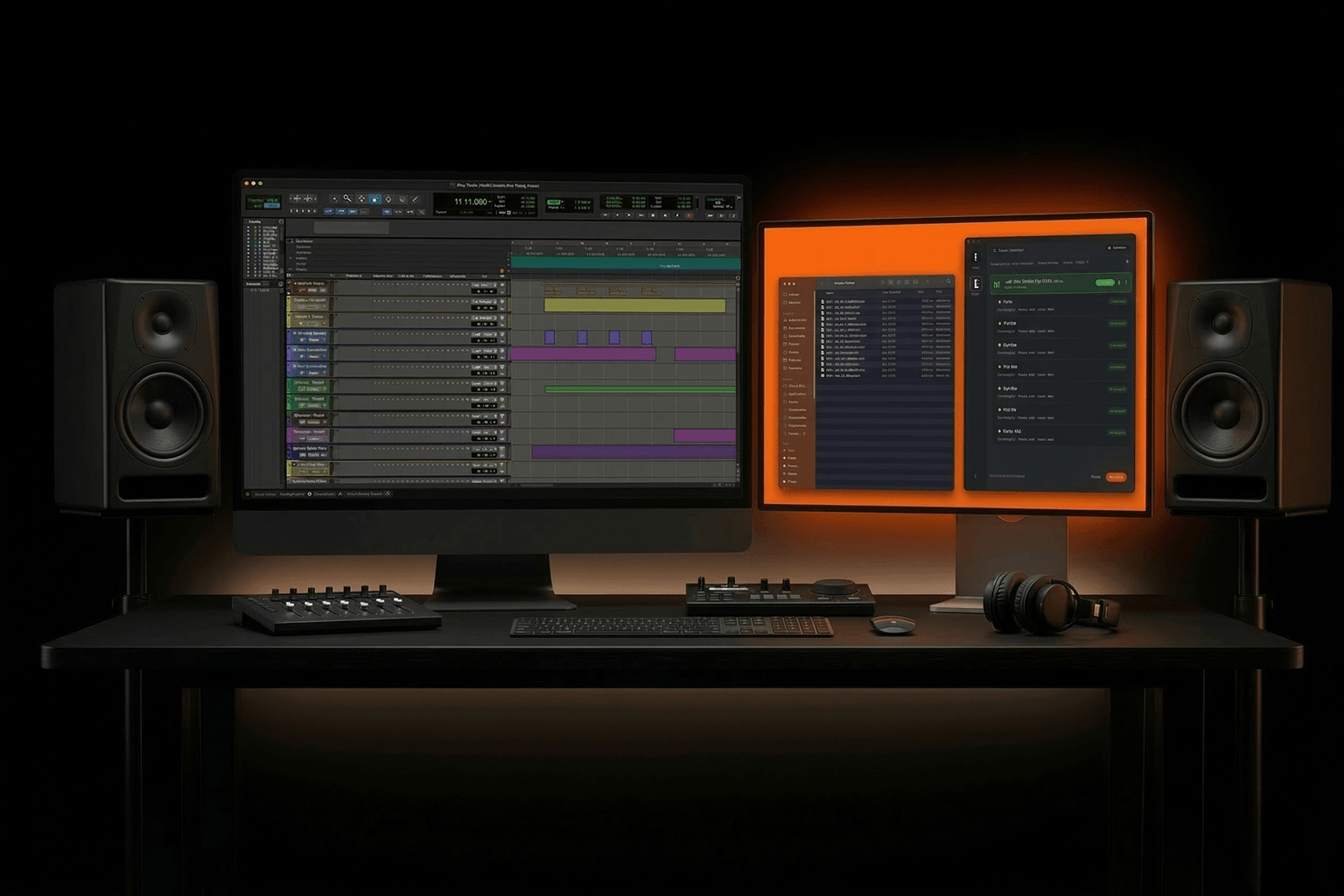
This is exactly the layer fMusic automates on import. AI-R reads the audio content of each file, identifies the instrument, and maps everything into your template with Auto routing, Auto color-coding, and Auto renaming applied in one pass. Pro Tools 2024.3+ and Logic Pro 11.1+ are supported on macOS 11 or higher. See the full breakdown in the Pro Tools session template guide.
2. Gain Stage Before You Touch a Fader
Gain staging is the fundamental that gets covered constantly and skipped constantly.
Every track sums to the same stereo output. If your individual tracks are hitting too hot, the mix bus is already clipping before a creative decision has been made. Too quiet and you fight noise floor on every fader move. Produce Like a Pro's body of gain staging material is one of the cleanest reference points on this practice for working engineers.
Standard practice across pro mix workflows looks like this:
| Stage | Target level (RMS / peak) | Why it matters |
|---|---|---|
| Individual tracks | Around -18 dBFS RMS, peaks under -6 dBFS | Headroom for plugins, buses, parallel processing |
| Group bus output | Peaks under -3 dBFS | Clean summing into the mix bus |
| Mix bus | Peaks under -1 dBFS pre-limiter | Headroom for mastering, no inter-sample clipping |
The workflow rule is to deal with gain on import, not mid-mix. If stems come in at wildly different levels, spend five minutes normalizing them to a consistent reference before opening the first plugin. You stop compensating with EQ and compression for what is a level problem.
The single most useful gain-staging move from working engineers: if the master fader is clipping on playback, grab all your tracks and pull them down together. Do not pull the master fader down. Your individual faders need room to move. That is where your mixing decisions live.
3. Strip Silence to a Clean Foundation, Then Mix Into It
Session cleanliness is not aesthetic. It changes what you hear.
A 40-track session full of untreated open tracks stacks noise across every channel. High-pass filters left off guitars are adding low-frequency rumble to the mix bus. Regions that have not been stripped of silence keep adding room tone, mic bleed, and headphone spill into your sum. The engineers who handle this consistently do it before they make creative decisions, not while they are making them.
The honest workflow split for strip silence looks like this:
| Pass | Goal | Who owns it |
|---|---|---|
| Broad strip silence | Remove obvious silent regions, preserve tails and natural decay | Can be automated. fMusic's Strip silence runs this pass safely on import without cutting off musical tails. |
| Capillary edits | Tighten verses, gate ambient bed, clean specific phrasing | Engineer keeps this. These choices are tied to the mix, not the prep. |
| High-pass on non-low instruments | Cut rumble below 80-120 Hz on tracks that do not need it | Engineer keeps this. Frequency choices are mix-stage decisions. |
| Mono-correct fake stereo | Identify dual-mono files exported as stereo and collapse | Can be automated. fMusic's Stereo to mono catches this on import. |
The point of automating the broad pass is not to remove the engineer from the chain. It is to leave a clean foundation so your edit time goes to the choices that shape the song.
4. Use Reference Tracks From the First Decision
Most engineers know they should use reference tracks. Most do it too late.
The habit that separates a professional workflow from a bedroom one is loading the reference before any mixing decisions, not at the end when something feels wrong.
The setup is straightforward:
- Import a professionally mixed track in a similar genre and at a similar tempo and energy.
- Reduce its level until its perceived loudness roughly matches your mix.
- Route it so you can A/B without removing master bus processing from the picture.
That gives you a calibrated benchmark. Low end should sit in a comparable weight range. The vocal should occupy a similar space in the high-mids. The overall width should feel comparable.
One critical detail mastering engineers keep repeating: do not use a mastered reference as a loudness target while mixing. Match by ear for tonal balance and frequency weight, not raw level. Your mix should have headroom. The mastered version does not.
🎯 Big picture first. Before reaching for plugins, listen to the rough balance against your reference for a full pass. Most working engineers form the high-level mix decisions (vocal forward or back, low end weight, stereo width) in the first listen, then spend the rest of the session executing on those decisions. Inverting that order (plugins first, perspective last) is how mixes turn out technically clean but emotionally flat.
5. Lock Your Routing Structure Before You Reach for a Plugin
Routing indecision is one of the most expensive forms of session time loss.
Bus processing is a core part of how pros work. Brauer's multi-buss approach routes different instrument groups through different processing chains and then into summing mixers, giving him tonal control at the group level before anything hits the master bus. Whatever specific routing you adopt, the productivity point is the same: decide once, systematically, and stick with it.
Routing changes mid-mix are expensive. They require you to re-check levels, re-verify that print tracks are receiving the right signals, and potentially redo automation. Getting routing right during session prep, while you are in a systematic rather than creative headspace, protects you from all of that.
This is also where automated import pays compounding dividends. fMusic's Auto routing maps incoming files to the bus structure already wired into your template, so the routing layer is done by the time you open the session. The template stays the source of truth, and every new session inherits it unchanged.
6. Wire Print and Stem Delivery Into Session Prep, Not Into Delivery Night
This is the workflow habit most engineers only discover after they have delivered a project late because the export phase took three hours they did not plan for.
Pro sessions involve printing multiple versions of every song. Vocal up, vocal down, instrumental, TV mix, stem deliverables, alt mixes for sync. Each one needs the correct signal flow in place before the bounce. Doing this once, inside the template, makes the export phase a batch operation instead of an end-of-night manual task.
This is the layer fMusic's export module is built around:
| fMusic export feature | What it does | What it replaces in the manual workflow |
|---|---|---|
| Favorite stem prints | Reusable stem configurations saved once and applied per session | Rebuilding print groups every project |
| Multi-format bounce | Renders WAV, AIFF, MP3, and other format combinations in one pass | Re-bouncing the same mix three times for three deliverables |
| Multi-session flow | Queues multiple sessions and processes them in sequence | Babysitting Pro Tools through an evening of bounces |
| Custom categories | Stem groupings defined to match how you deliver | Manually flagging tracks for each stem bus |
| Mix template integration | Export logic lives inside the same template that holds your routing | Reconnecting print tracks per project |
Ricky Damian, the Grammy-winning producer featured on the Forte AI channel, has spoken about reclaiming hours per week that were previously lost to this exact prep-and-print layer. Production Expert's hands-on coverage of fMusic covers the same observation from the industry side.
For a deeper look at the export side specifically, see the breakdowns of batch bounce in Pro Tools and stem export automation in Pro Tools.
Manual Prep vs Automated Prep, Side by Side
The habits above are universal. The way you apply them is a choice.
| Session prep step | Manual workflow | Automated with fMusic |
|---|---|---|
| File import + organization | Drag, rename, color-code, route track-by-track | AI-R reads content, applies template routing, naming, and color in one pass |
| Mono correction | Audition each "stereo" file, collapse dual-mono manually | Stereo to mono catches and collapses on import |
| Strip silence (broad pass) | Run strip silence per track, set thresholds individually | Safe pass across the session, tails preserved, capillary work left to engineer |
The point is not that automation replaces the engineer. It replaces the work the engineer should never have been doing in the first place. The decisions about how the mix sounds stay with you. The plumbing work that sits in front of those decisions does not have to.
Pricing
fMusic is generally available and self-serve, with a 7-day free trial that does not require a credit card. Every paid tier includes 2 seats and unlimited files.
| Tier | Price | Billing | Best for |
|---|---|---|---|
| Monthly Access | €18 | Per month | Trying fMusic at the cadence of a single project cycle |
| Yearly Access | €109 | Annual (50% saving vs monthly) | Working engineers running regular session volume |
| Lifetime | €499 | One-time, lifetime updates | Engineers and facilities committing to the workflow long-term |
| Free trial | 7 days | No credit card | Anyone wanting to see fMusic on their own session before paying |
Full breakdown on the fMusic pricing page.
The Common Thread in Every Workflow Habit
Across all of these habits, from Brauer's template structure to standard gain staging practice to how high-volume engineers prep their sessions, the underlying principle is the same.
Decisions made under creative pressure are worse than decisions made systematically before the creative work begins. Every habit above is a version of: do the mechanical work early, do it correctly, and leave session time for what requires your ears.
You can do that prep work manually. Or you can let fMusic do it. The engineers who mix well and mix fast are not doing anything mysterious. They are protecting their attention.
Frequently Asked Questions
What are the 5 steps of a mixing workflow?
Most published workflows agree on the broad sequence: (1) organize and balance, (2) process individual tracks with EQ and compression, (3) bus processing and effects, (4) automation, and (5) print and deliver. The piece most working engineers leave out is the prep step that sits in front of all five: template, routing, gain structure, references, strip silence, and print tracks set up before any mixing decisions begin. That is the layer this article covers.
What is the golden rule of mixing?
The most consistent principle across professional mix engineers is leave yourself headroom. Track levels at around -18 dBFS RMS, peaks under -6 dBFS on individual channels, and the mix bus peaking under -1 dBFS before any mastering processing. The reason is mechanical: every plugin, bus, and parallel chain adds gain. If you start hot, you end up clipping by the time you reach the master fader, and your only options become destructive.
What is the most important mixing workflow habit for professional engineers?
A consistent mix template ranks at the top across most pro workflows. It eliminates routing decisions from every new session and gives you a known starting point. The template becomes the source of truth that every new project inherits.
How should you gain stage tracks before mixing?
Aim for tracks averaging around -18 dBFS RMS with peaks under -6 dBFS. If the mix bus is clipping on playback, grab all faders and pull them down together rather than touching the master fader. Your individual faders need room to move.
When should you use reference tracks in a mix?
Load your reference before any mixing decisions, not after the mix is finished. Match its perceived loudness to your mix and use it to calibrate tonal balance, low end weight, and vocal placement throughout the process. Do not match the loudness of a mastered reference; your mix needs headroom.
What is bus processing and why do professional engineers use it?
Bus processing routes groups of similar instruments through shared channels and applies processing at the group level. It gives engineers tonal control over whole sections of the mix before anything hits the master bus, and it is a core part of how engineers like Michael Brauer have developed their signature sound.
Does automating session prep mean giving up creative control?
No. The point of automating prep is to remove the non-creative layer (file routing, naming, color coding, broad strip silence, mono correction, and print track setup) so the creative decisions get more of your attention. The choices that shape the mix stay with the engineer.
Which DAWs work with fMusic today?
fMusic supports Pro Tools 2024.3+ and Logic Pro 11.1+ on macOS 11 or higher.
What does fMusic cost?
Monthly Access is €18, Yearly Access is €109 (50% saving), and Lifetime is €499 with lifetime updates. Every paid tier includes 2 seats and unlimited files. A 7-day free trial is available without a credit card.
Stop Rebuilding Sessions. Start Mixing Them.
The session prep layer is the same across every project, which is why it is the layer most worth automating. If you want to see how Auto routing, AI-R, Strip silence, Stereo to mono, Favorite stem prints, Multi-format bounce, and Multi-session flow change the shape of a working session, the place to start is the fMusic product page and the fMusic pricing page. Full review write-ups: Ed Thorne on fMusic, MixbusTV on fMusic, and Wayne on Forte AI.
About the author: Loris Comba is Co-founder and CEO of Forte AI, an audio automation entrepreneur focused on eliminating repetitive operational tasks in professional audio production. Forte AI builds fMusic (mix prep and stem export automation) and fPost (audio post production automation) for Pro Tools and Logic Pro.